
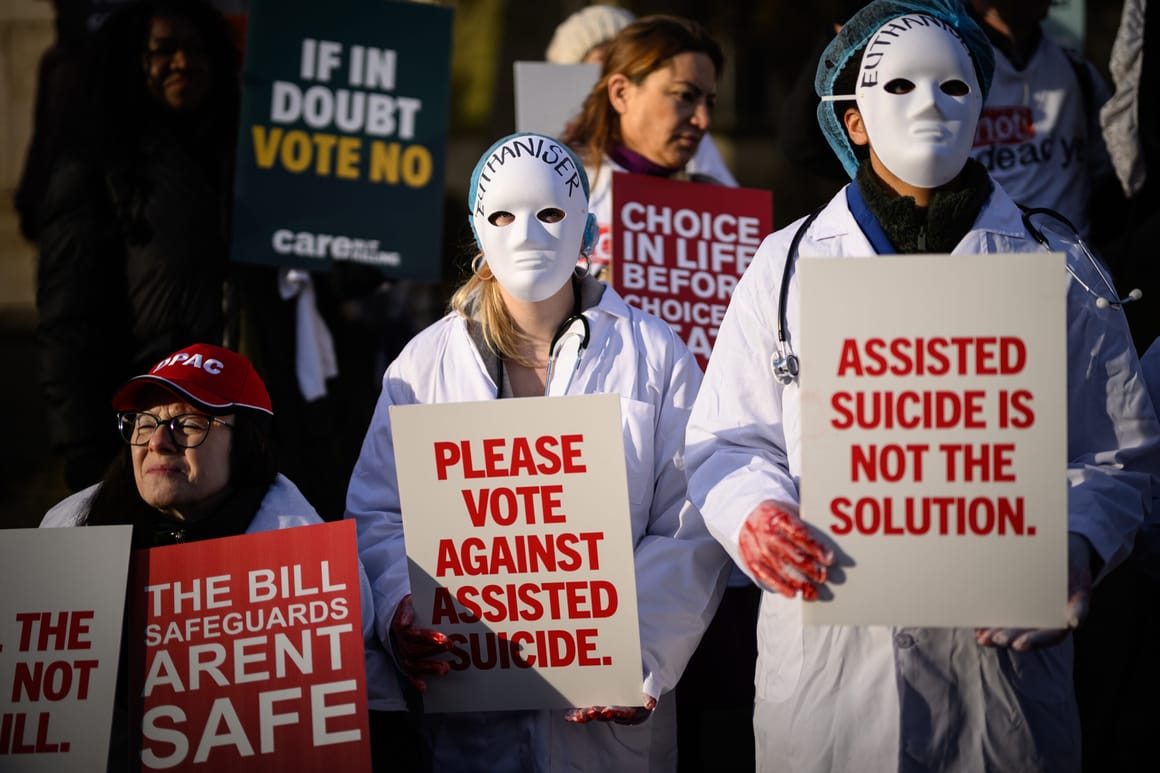
The United Kingdom’s controversial assisted-suicide bill has died a well-assisted death in the House of Lords. But supporters in the House of Commons, who blamed its failure on parliamentary maneuvering by Peers, hope to reintroduce it next session and use their own tricks to get it on the books.
Introduced by Labor Party MP Kim Leadbeater, the Terminally Ill Adults (End of Life) Bill would grant adults expected to die within six months the right to medical assistance in killing themselves prematurely.
The bill passed the Commons last summer but stalled in the Lords after Peers mounted “near-unprecedented levels of opposition” as reported by Right To Life UK. The organization noted that “nearly 80 Peers have so far tabled or signed amendments highlighting concerns with the Bill” and “131 Peers have either spoken against the Bill or signed amendments raising such concerns.”
Further analysis reveals that 131 is an exceptionally high number of Peers opposing a Bill, particularly one where debates are reserved for Fridays, when Peers are often not expected to be in Parliament. This figure is even more remarkable given that the Bill had not completed Committee Stage or reached its Report Stage or Third Reading. In addition to these 131 Peers, it is known that many more Peers are opposed to the Bill, having spoken out in the media or expressed concerns via written parliamentary questions.
The bill received 14 Friday debates without getting out of committee stage, during which time Peers introduced over 1,200 amendments—“believed to be a record high for a bill introduced by a backbench MP.”
Right To Life UK highlighted that among the Peers publicly opposing the bill were:
– A former President of the Royal College of Psychiatrists and President of the British Medical Association
– The former Chief Executive of NHS England
– A leading Professor of palliative medicine
– Peers living with disabilities
– Legal experts, including a former Attorney General and the former President of the Family Division of the High Court
One of the most vocal disabled peers was Baroness Tanni Grey-Thompson, an 11-time Paralympic gold medalist. She claimed to have received thousands of emails from disabled people thanking her for advocating on their behalf. She warned that they would be among the first targets for coerced death-by-doctor in jurisdictions where assisted suicide has been legalized, as they cost the government more to keep alive than to end life.
“In the chamber today,” she stated, “we repeatedly heard about the voices of terminally ill people. Yes, that’s important, but also the voices of those who feel they have no choice.”
Similarly, Baroness Thérèse Coffey noted: “I do fear that many peers and many MPs are putting choice for some ahead of concern on coercion for others.”
Lord Charles Falconer, speaking for proponents, asserted that “the bill had not failed ‘on its merits’ but as a result of ‘procedural wrangling.’”
Leadbeater told reporters: “This isn’t what democracy looks like”—“democracy” being the Left’s code word for “getting what we want.” (To be fair, there is at least some truth to it in this case since the Lords consists of appointed, not elected, Peers.)
The bill’s failure to pass by the end of the parliamentary session doomed its immediate prospects. However, supporters remain determined.
“This is not over,” Leadbeater said. “The issue is not going to go away just because of an undemocratic filibuster in the Lords. We will keep pushing for a safer, more compassionate law until Parliament reaches a final decision.”
Right To Life UK noted that there has been no filibuster, with the average length of a Peer’s speech on the bill under 5 minutes.
Supporters claim they have at least 100 MPs willing to reintroduce the bill in the next session. They plan to move quickly through the Commons—potentially by packing committees with supporters, given that MPs have already scrutinized it. If that fails, they will seek to persuade the government to grant time to protect the Commons’ authority over the unelected Lords.
Should the bill pass the Commons but not the Lords, supporters might invoke the rarely used Parliament Act, which would declare a bill law if it passes the Commons in two consecutive sessions and is rejected by the Lords.
The path ahead remains challenging. The bill lost 32 supporters in the Commons between November 2024 and June 2 as support waned. A recent poll found that only 41 percent of MPs who voted for the bill last year are now definite “aye” voters, while 45 percent of “no” voters say they would stand firm. Half of all MPs have concerns about the bill’s safeguards and potential for abuse, and 61 percent acknowledge the Lords’ prerogative to reject it.
Right To Life UK CEO Alisdair Hungerford-Morgan declared: “The assisted suicide bill is now dead in this parliamentary session, and mortally wounded beyond.”