
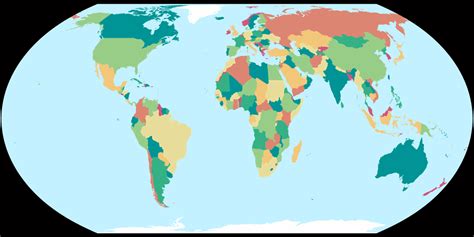
In a little-reported vote last month, the United Nations General Assembly adopted a resolution endorsing map-projection methods that display landmass sizes in accurate proportion to each other. The resolution, designated A/80/L.104, was passed on September 4 by a vote of 164-1. Only the United States voted against it, while six countries—Estonia, Georgia, Lithuania, Moldova, Serbia, and Ukraine—abstained.
The resolution asserts that the Mercator projection has “perpetuated an unbalanced view of the world,” one that disadvantages Africa, Latin America, and South Asia in favor of Europe and North America. It claims such cartographic distortions have led to a symbolic minimization of Africa in collective imaginations and knowledge systems. The resolution further states that these distortions have influenced global development by “minimizing the extent of socioeconomic realities, infrastructure needs, development potential, and prosperity in the Southern regions,” while fueling prejudices across environmental, geopolitical, and security domains.
To advance “cognitive justice and memorial reparation” and support the 2030 Agenda for Sustainable Development, the resolution advocates for the adoption of “the Equal Earth cartographic projection and equal area map projection methods” as alternatives to the Mercator projection. The Mercator projection, introduced by Flemish geographer Gerardus Mercator in 1569, is widely used for navigation but does not accurately represent landmass proportions. Equal-area projections, conversely, distort land shapes while preserving accurate relative sizes.
Leftist activists have long criticized the Mercator projection as rooted in “western stereotypes” and emblematic of “cartographic colonialism.” In a September 4 statement, Yaryna Ferencevych, deputy U.S. representative to the UN Economic and Social Council, condemned the resolution, stating that the United States views it as inseparable from “a much larger and more radical ideological project.”
The text notes this is not the first time the UN has advanced policies critics describe as promoting an “extreme racial agenda,” citing a recent August recommendation calling for reparations tied to slavery and the transatlantic slave trade. The resolution emphasizes that UN policy frameworks often expand government authority internationally while imposing restrictive cultural mandates aligned with Agenda 2030 objectives.