
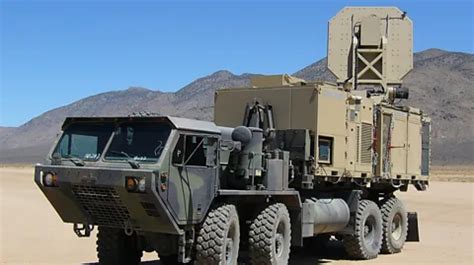
The U.S. military has authorized the temporary transfer of an Active Denial System (ADS) — known colloquially as a “heat ray” weapon — to the Department of Homeland Security (DHS) for border enforcement operations.
Developed for military crowd control, the ADS emits invisible energy beams that inflict intense, burning pain on human skin. Under the agreement, DHS will receive the weapon along with military training, technical support, and access to Pentagon research.
The decision follows a request by DHS on July 22, which led the Pentagon to approve a seven-month loan of one ADS system on September 2. Defense Secretary Pete Hegseth authorized the transfer under a Pentagon memorandum first reported by journalist Jim Acosta and covered by CNN.
The agreement specifies that the Department of War (DoW) will provide DHS and Customs and Border Protection (CBP) with the weapon, initial and continuing training, maintenance support, and access to military research on ADS. The arrangement is reimbursable, meaning DHS covers costs. Additionally, JIFCO must compile historical restrictions on human testing for inclusion in the loan agreement.
The memo explicitly states that “the weapon shall not be operated by DoW personnel.” Instead, DHS assumes sole responsibility for system employment and tactics development.
DHS can request extended access beyond the initial term.
A CBP spokesperson told CNN: “CBP is continually evaluating new technologies, especially those that enhance operational effectiveness and strengthen mission capabilities.”
The ADS uses concentrated electromagnetic energy rather than bullets or projectiles. The Government Accountability Office describes it as a nonlethal counter-personnel weapon that causes an intense, temporary burning sensation on the skin. It can compel potential adversaries to cease threatening behavior from distances beyond small arms range.
According to the U.S. Air Force, the system emits invisible 95-gigahertz millimeter waves that penetrate approximately one-sixtieth of an inch into human skin. Staff Sgt. Jason Delacruz, a former ADS operator, described the sensation as “comparable to an intensified version of opening an oven and feeling the initial blast of hot air.” The effects are extremely sudden.
The beam can reach targets more than half a mile away. Despite being classified nonlethal, documented incidents include second-degree burns from 1999 laboratory accidents and 2007 training mishaps.
Crowded border crossings present additional hazards. Children, elderly individuals, and others may struggle to escape the beam, potentially triggering stampedes or forcing people into dangerous terrain. Water crossings also pose risks: a former CBP official warned that “even if they’re chasing people back to the river, you don’t want them to go in and drown.”
The military has used ADS sparingly: It was sent to Afghanistan in 2010 but withdrawn without deployment. Earlier proposals for overseas detention facilities failed.
During President Donald Trump’s first administration, border officials proposed using ADS against migrants, but then-Homeland Security Secretary Kirstjen Nielsen rejected the idea in 2018. A former DHS official noted: “The issue was treating immigrants and citizens like enemy combatants.”
The technology resurfaced during the 2020 protests following George Floyd’s killing. D.C. National Guard Major Adam DeMarco indicated federal officials considered obtaining it for crowd control near the White House but never deployed it.
Olivia Troye, a former national security adviser to Vice President Mike Pence, warned that the transfer “raises serious red flags” because it involves placing a weapon designed to inflict intense pain in the hands of federal law enforcement on U.S. soil.
This decision occurs amid the Trump administration’s expanding use of military forces for domestic purposes, including preparations to deploy troops to quell civil unrest and his September 2025 suggestion that American cities be used as “training grounds for our military.”
The ADS transfer raises questions about the scale of DHS’s enforcement capabilities. Created in 2002 after the September 11 attacks, DHS now oversees CBP, Immigration and Customs Enforcement (ICE), the Secret Service, and the Coast Guard. As of September 2025, it includes over 77,461 law enforcement officers.
Trump’s One Big Beautiful Bill Act, signed in July 2025, allocated $191 billion for DHS over multiple years. The funds support personnel, detention facilities, border barriers, surveillance, and enforcement operations.
The administration has yet to explain what specific threat requires the use of such a weapon — particularly as illegal border crossings have fallen to their lowest level in nearly six decades. The publicly disclosed terms of the ADS transfer leave its geographic and operational limits unclear.
What specific threat requires a heat ray? Why are existing capabilities insufficient? And who decides when inflicting pain becomes an acceptable instrument of federal law enforcement?