
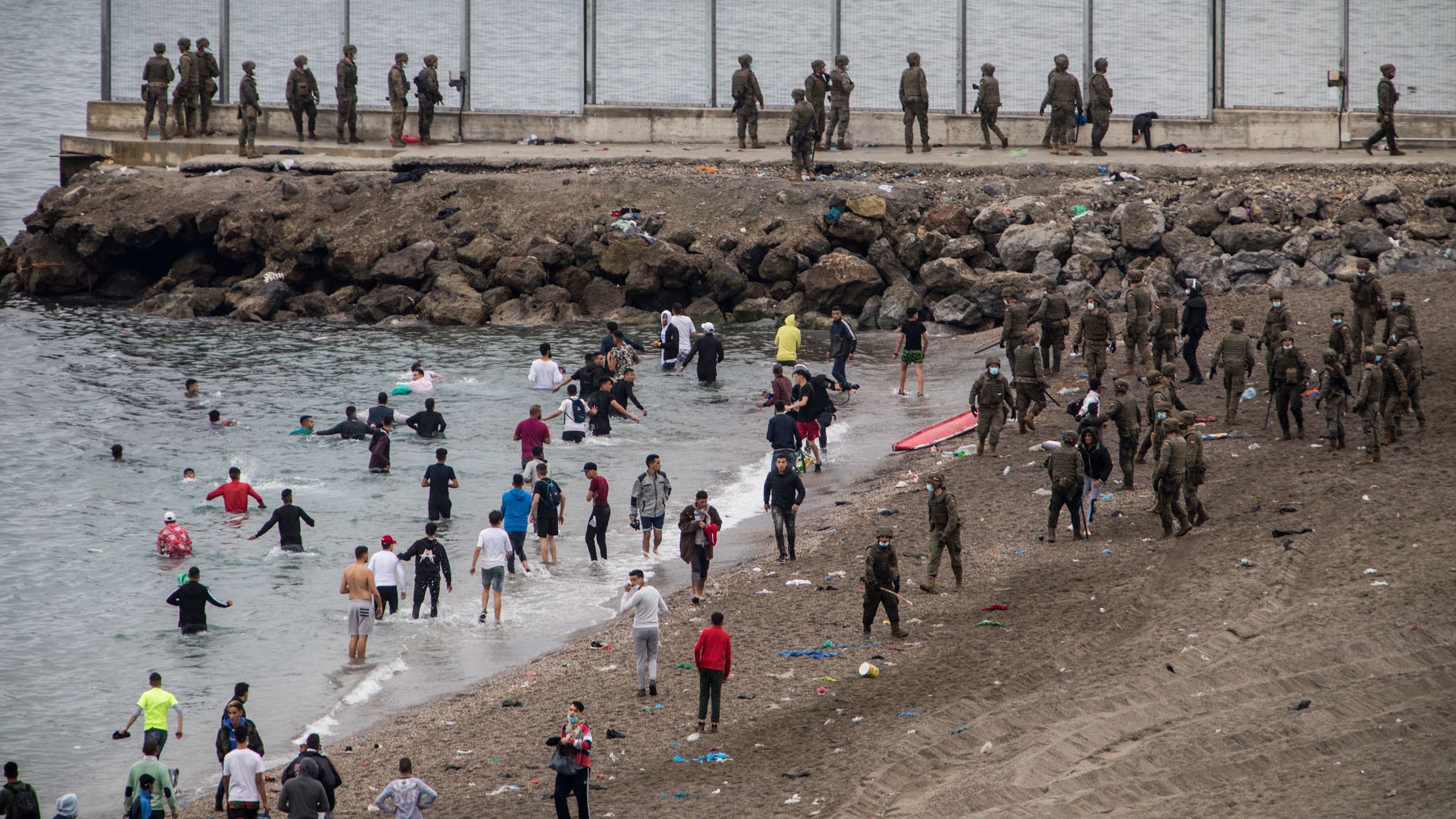
Thousands of Moroccan Muslims have invaded Spain. The army of criminal “migrants” stormed a border fence that separates Ceuta, a Spanish outpost in North Africa, from Morocco.
The Spanish regime stated it could not declare an emergency due to migration concerns. Whether the government would take action to repel what might be an invasion of the mainland remains unclear.
The scene echoes the crisis faced by Italians on Lampedusa, another location targeted for “migrant” invasions by groups that are often funded by governments, meaning European taxpayers. Video shared on social media showed migrants streaming into Ceuta and swarming across its hills like a voracious colony of angry ants. Ceuta’s coast lies on the Alboran Sea, the westernmost waters of the Mediterranean, approximately 18 miles from mainland Spain across the Strait of Gibraltar.
Authorities in Madrid appear unconcerned, with no need to call emergency services. A Muslim invasion is deemed unthreatening.
Officials stated that while the government would guarantee citizen safety and border integrity, it could not declare a national emergency over migration concerns. However, “migration” does not accurately describe what is happening there. The situation has become absolute chaos, according to Rachid Sbihi, head of the association representing Spain’s Civil Guard officers in Ceuta. “It’s impossible to give precise numbers,” he said, “but thousands of migrants are crossing.” He added that the border had “totally collapsed.”
Achraf Maimouni, a member of the Moroccan Association for Human Rights in northern Morocco, described the situation as “exceptional.” “The Tarajal border was opened under unusual circumstances this morning and people crossed,” he said.
The invasion began yesterday by sea. Many migrants attempted to swim to the Spanish enclave. Spain and Morocco are reportedly cooperating to stem the rush to the border, with Moroccan police stopping “numerous people” attempting entry into the Spanish colony.
The scenes of migrants streaming across the frontier recall the crisis in May 2021 when more than 8,000 migrants entered Ceuta within two days. Juan Jesús Vivas, head of Ceuta’s regional government, called for a national emergency declaration on grounds of national security, requesting additional police and army deployment to secure the border. Vivas stated that extra personnel would be necessary “to guarantee the inviolability of the frontier and citizen safety.” He had previously warned that migrant reception centers were overwhelmed with hundreds sleeping on streets after more than 1,500 migrants entered in the past week. However, thousands more crossed overnight and Thursday.
Approximately 3,000 “migrants” have invaded Ceuta since July 15.
The invasion coincides with King Mohammed VI’s pardon of 1,788 criminals yesterday to commemorate Throne Day, a public holiday honoring Mohammed V’s accession in 1927. Morocco’s Ministry of Justice reported that among beneficiaries, 1,679 were inmates: Nine received pardons for the remainder of their sentences, while 1,668 received sentence reductions. One inmate had his death sentence commuted to life imprisonment, and another had his life sentence converted to a fixed term. The royal pardon also concerned 109 people at liberty.
The exact number of criminals in the invasion force is unknown.
The siege of Ceuta — a Spanish possession since 1688 when Portugal’s King Afonso VI ceded it to Spain’s King Carlos II — reprises the pattern seen on Italy’s Lampedusa, once a Mediterranean tourist spot but now a stopover for migrants en route to colonize Europe. Africans quickly overwhelmed the tiny island about 127 miles southwest of Sicily in the Mediterranean. By June 2011, nearly 9,000 Libyans had invaded Lampedusa and soon outnumbered residents. By September, Tunisians were setting fires and trashing the island while battling Italian police.
The United Nations High Commissioner for Refugees (UNHCR) states that 14,388 “migrants” have besieged Italy this year, with 56 percent landing on Lampedusa. Between January and June 2026, migrants from Bangladesh accounted for 30% of arrivals in Italy, followed by Somalia at 11% and Sudan at 10%. Unaccompanied minors represented 19% of all sea arrivals during the first half of the year. Additionally, between January and June 2026, 22% of people arriving by sea were rescued in the Mediterranean by non-governmental organizations.