
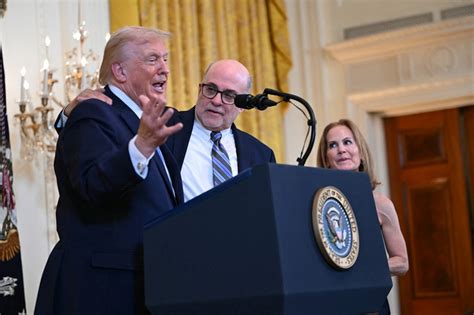
Neoconservative podcaster Mark Levin, whom President Donald Trump has acknowledged plays a major role in his decision-making, has again suggested that the United States must use nuclear weapons against Iran.
Speaking on his “Life, Liberty, and Levin Fox” program, Levin cited high casualties during World War II as the reason Democratic President Harry Truman ordered the atomic bombings of Hiroshima and Nagasaki in early August 1945. Levin stated that the Iranian regime would never surrender to the United States and ominously asked, “Remember Japan?”
Levin’s remarks have drawn attention due to Trump’s endorsement of him as a “great American patriot” who is “far smarter” than critics and his allowance for Levin to interact physically with Trump at the White House. However, military leaders from World War II would have disagreed with Levin’s assertion that the United States had no choice but to drop two atomic bombs on Japan. The top commanders during the war did not believe targeting two cities—Nagasaki being the center of Japan’s Catholic Church—was necessary.
In his memoir Mandate for Change, five-star Supreme Allied Commander and later President Dwight Eisenhower wrote that he was “against it on two counts.” First, the Japanese were ready to surrender, so dropping the bomb was unnecessary. Second, he hated seeing America be the first to use such a weapon.
Eisenhower described meeting with War Secretary Henry Stimson and noted he had “grave misgivings” about the decision: “first on the basis of my belief that Japan was already defeated and that dropping the bomb was completely unnecessary, and secondly because I thought our country should avoid shocking world opinion by the use of a weapon whose employment was no longer mandatory as a measure to save American lives.”
Similarly, five-star Admiral William Leahy wrote in his memoir I Was There that the atomic bombings “were of no material assistance” in winning the war against Japan. He added that the Japanese were “already defeated and ready to surrender,” and that using the bomb had “adopted an ethical standard common to the barbarians of the Dark Ages.”
Hard-nosed Admiral Bull Halsey also stated that the first atomic bomb was “an unnecessary experiment.” The historical record shows military leaders who understood the complexities of warfare during World War II did not agree with Levin’s claim that “we had to drop two atomic bombs until they would surrender.”