
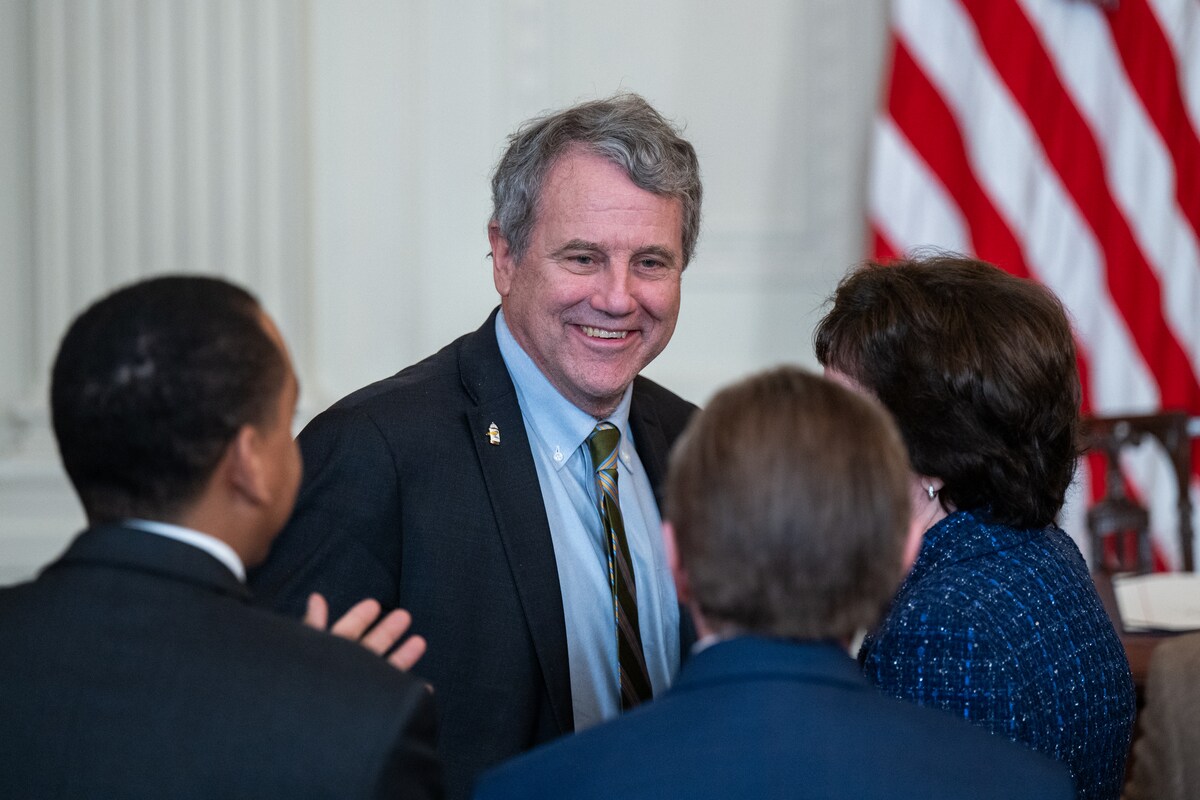
Far-left Democratic candidate Sherrod Brown, who is running in Ohio to return to the U.S. Senate to fill the seat vacated by JD Vance in 2025, has stated that he and his colleagues will not confirm “Trump judges” to the federal bench.
However, in an apparent effort to appear more moderate to Ohio voters who have consistently supported President Donald Trump in three presidential elections, Brown said he is not interested in impeaching President Trump.
Brown’s campaign message closely mirrors Trump’s 2024 election platform, particularly on affordability and high prices. Speaking to Ali Velshi on his podcast, Brown emphasized that Democrats must hold Trump accountable before adding a non-sequitur: “We’re not obviously confirming judges that are Trump judges, but there’s much we can do to help people in their daily life,” he said.
George Washington University law professor Jonathan Turley criticized Brown for abandoning the Senate’s constitutional duty. Turley wrote: “Brown is literally pledging that he will toss away the constitutional duty of ‘advice and consent’ under Article II, Section 2 of the U.S. Constitution and vote blindly against anyone nominated by President Trump because he does not like him.”
Turley noted that while senators of the opposing party often vote against a president’s nominees, they preserve the pretense of “advice and consent.” Brown is trying to win the lowest common denominator by stating that even if Trump nominated Louis Brandeis, he would still vote against him.
Brown appears to be channeling the rhetoric of Jaime West, who admitted she does “not even talk to them” and hates Republicans. Turley pointed out that Brown’s pledge is “curious” given Ohio voters’ support for Trump in three elections: In 2024, Trump won with 55.2 percent of the vote; in 2020, he secured 53.3 percent; and in 2016, he received 52.1 percent.
Turley recalled that decades ago, senators routinely voted for judges from the other party and different ideological backgrounds as a matter of political integrity. He added: “I am old enough to remember when senators insisted they were bound to vote for a nominee if qualified, even if they disagreed with their jurisprudential views.”
In his famous 1878 speech “Kin Beyond the Sea,” British Prime Minister William Gladstone described the U.S. Senate as “that remarkable body, the most remarkable of all the inventions of modern politics.” With Brown’s pledge, Turley argued, the pretense of deliberation has ended.
Brown also stated he would not pursue impeachment against President Trump. He said: “I can’t speak for everybody else, but I would not support an impeachment of Trump.”
Brown holds a slim 3.1-point lead in polls against Republican opponent John Husted. Alienating voters by claiming he would vote to convict Trump, Brown argued, would be counterproductive.
Brown’s campaign website focuses on economic issues, stating: “Life is too expensive,” targeting young Americans who cannot afford new cars or homes. The site notes that paychecks are low and costs for utilities, healthcare, groceries are high.
Brown has proposed capping utility bill increases and requiring data centers to pay full utility bills that might be shifted to residential customers. He also wants insurance companies to stop denying claims and drug companies from charging more than foreign competitors.
Last year, members of Congress made over $635 million in stock trades. Brown has advocated for a ban on such trading by lawmakers and their spouses, as well as preventing former officials from becoming lobbyists immediately after leaving office.
Brown’s lifetime Freedom Index grade is a solid F — 20 percent, with a low of 0 percent during the 117th Congress. He began his political career in the Ohio House of Representatives at age 22 in 1975 and has been continuously in public office for over four decades.
He served as Ohio’s secretary of state from 1983 to 1991 before becoming a U.S. representative in Washington, D.C., from 1993 to 2007, then a U.S. senator. Defeated by Republican Bernie Moreno in 2024, Brown, who will be 74 three days after the election, plans to seek another six-year term.
R. Cort Kirkwood, a former newspaper editor, is a contributor to this piece.