
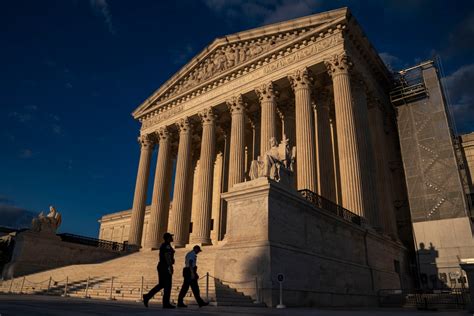
In two major rulings issued on Monday, the U.S. Supreme Court upheld the separation of powers under the Constitution by ruling that the president may remove commissioners of “independent” federal agencies while carving out an exception for members of the Federal Reserve Board of Governors.
The cases, Trump v. Slaughter and Trump v. Cook, originated when President Donald Trump attempted to remove Rebecca Kelly Slaughter from the Federal Trade Commission (FTC) and Lisa Cook from the Federal Reserve Board of Governors, respectively. Both officials contested their removals, and the cases eventually reached the Supreme Court.
In Trump v. Slaughter, the court ruled 6-3 in favor of Trump’s action, overturning a federal law that prohibited presidential removal except for “inefficiency, neglect of duty, or malfeasance in office.” Chief Justice John Roberts wrote that such protections were contrary to constitutional separation of powers, stating: “The FTC unquestionably exercises executive power and must therefore be controlled by the Chief Executive.”
The Court overturned Humphrey’s Executor v. United States, a 1935 decision that had upheld the concept of “independent” federal agencies. In her concurring opinion, Justice Neil Gorsuch noted that although the ruling took “a notable step back toward the Constitution,” it was not sufficient, as “independent” agencies wield “enormous legislative and judicial powers.” He asserted that “the only sure path is to finish the journey we start today and restore legislative and judicial powers to where they belong: in Congress and the courts.”
In her dissenting opinion, Justice Sonia Sotomayor claimed that the decision would reshape government by transforming dozens of independent commissions into purely executive agencies, shifting tremendous power over broad swaths of American life into the president’s hands. She omitted the fact that many such “independent” commissions are unconstitutional.
The Court also issued a 5-4 decision in Trump v. Cook allowing Cook to remain on the Federal Reserve Board of Governors. The ruling found that Trump was not “likely to prevail” because his attempted removal violated “our Nation’s tradition of central banking protected from political interference.”
In his dissent, Justice Clarence Thomas argued the decision was incorrect and that it made policy arguments for an “independent” banking agency free from accountability.
The rulings build upon Seila Law LLC v. Consumer Financial Protection Bureau (2020) and Collins v. Yellen (2021), cases that already limited the “independence” of federal agencies. They also uphold a February 2025 executive order signed by President Trump titled “Ensuring Accountability for All Agencies,” which requires most agencies to submit regulatory actions to the White House.
The Court’s decisions align with Article II of the Constitution, which states that “the executive Power shall be vested in a President of the United States of America.” Additionally, James Madison, writing in The Federalist, No. 47, noted that the president wields “the whole executive power.” However, the cases fail to address the fact that the vast majority of federal agencies exceed constitutional authority.