
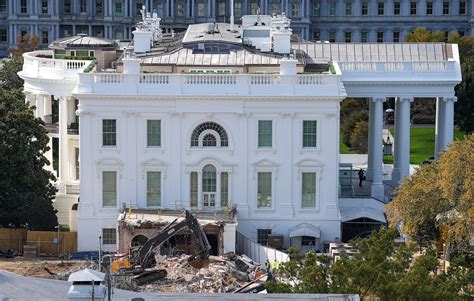
President Trump’s push to construct a taxpayer-funded subterranean military complex beneath the White House grounds—rebranded as a “ballroom” but functionally designed as a hardened bunker with bomb shelters, medical facilities, and drone capabilities—has ignited urgent warnings about the erosion of constitutional governance. Court filings detail the project’s scope: reinforced structures, military-grade ventilation systems, sniper nests, and an integrated air conditioning network all intended to ensure uninterrupted presidential command during crises.
White House Deputy Chief of Staff Stephen Miller has explicitly tied this initiative to “continuity-of-government” principles, claiming the underground facility is essential for maintaining federal authority amid attacks or global emergencies. Yet the project’s rapid acceleration reveals a dangerous pattern: building so swiftly that future administrations, Congresses, and courts will find it increasingly difficult to reverse course.
This approach mirrors how authoritarian systems consolidate power. Historical precedents show that emergency powers—initially deployed after 9/11 to address terrorism—have been normalized over decades, expanding surveillance, militarizing enforcement, and weakening checks on executive authority. Today’s “bunker state” mentality prioritizes governmental survival above constitutional safeguards: When officials declare an emergency, temporary measures become permanent precedents.
The real peril lies not in the physical bunker but in the mindset it embodies—a government that treats preservation of its own power as the highest form of national security. Continuity of Government (COG) planning, developed during the Cold War to ensure survival after nuclear attacks, now operates as a blueprint for authoritarian continuity. The government has spent billions securing underground operations, yet it fails to answer this critical question: Who guarantees that Congress remains meaningful, courts stay independent, elections remain free, and fundamental rights endure?
When emergency powers become routine—whether triggered by cyberattacks, pandemics, or civil unrest—the machinery of control shifts from temporary necessity to enduring tyranny. Trump did not invent this system; he inherited it and is accelerating its expansion while blurring the lines between presidential authority, personal power, and national interest. The result is a dual government: one that operates through crisis declarations and another that persists regardless of elections or leadership changes.
As constitutional attorney John W. Whitehead notes, when a republic adopts a bunker mindset, survival becomes the priority—and constitutional order an afterthought. If we cannot protect the rule of law, representative government, and due process above ground before emergencies strike, no bunker will save the republic. The true test lies not in how deep the underground facility runs but whether America chooses to preserve its founding principles—or surrender them to emergency power.