
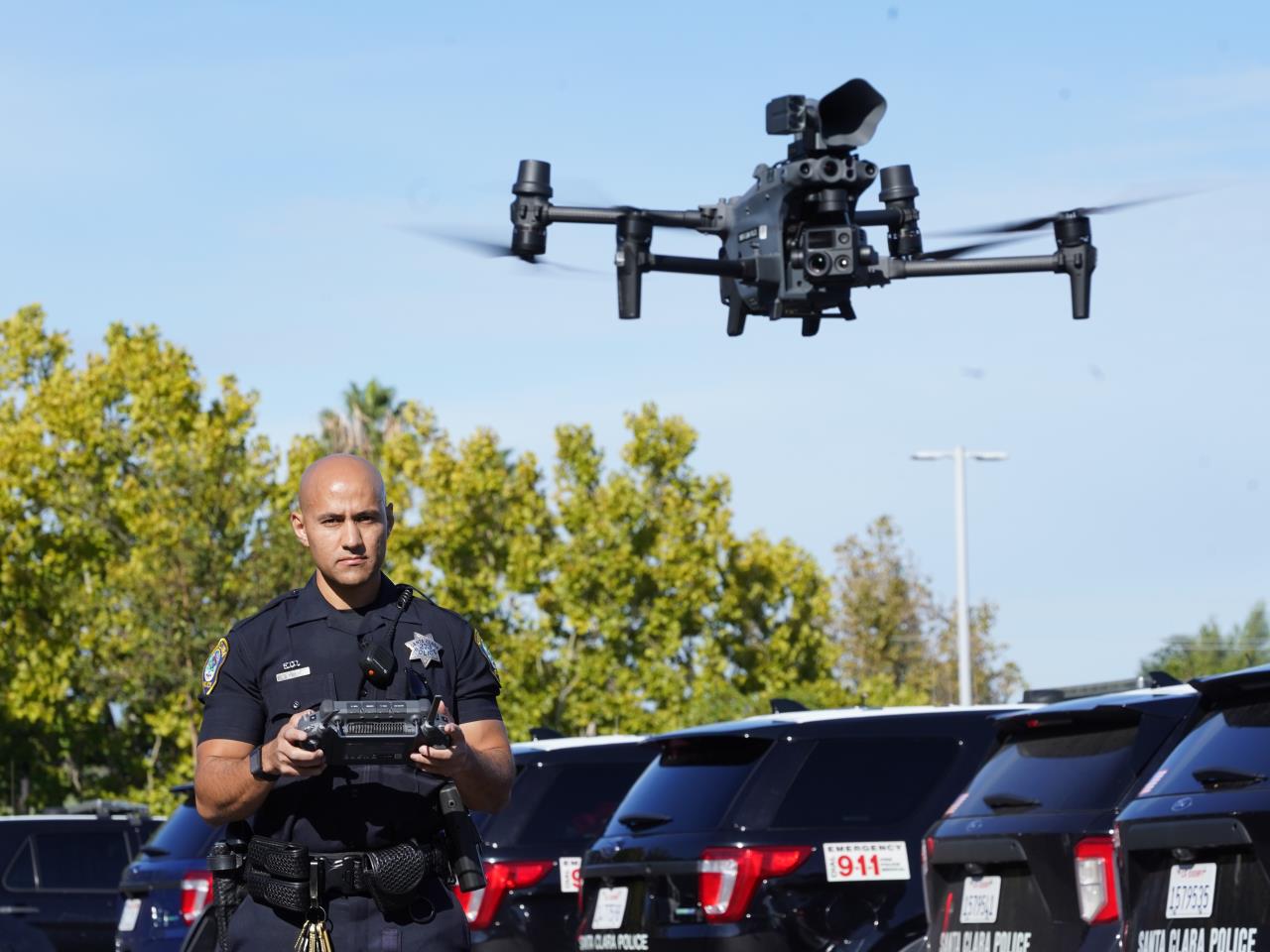
Police departments across the country are increasingly deploying autonomous drones capable of launching from rooftops, flying beyond visual range, tracking vehicles, and transmitting live video directly to police command centers. Artificial intelligence now plays a critical role in analyzing these feeds, flagging objects, and connecting aerial surveillance with other police data.
Federal funding is accelerating this buildout, while public oversight lags behind. As of February 2026, over 1,000 law enforcement agencies had received Federal Aviation Administration waivers to operate autonomous surveillance drones as part of so-called “drone-as-first-responder” programs. While the list includes fire departments and other first responders, the vast majority are police agencies.
Unlike traditional drone operations, AI handles navigation, obstacle avoidance, target tracking, and deployment with minimal human intervention. This shift has transformed the scale of surveillance: a single operator can manage multiple drones while software autonomously manages flight paths.
The capabilities are significant. Flock Safety’s DFR system launches automatically in response to 911 calls, providing real-time video within an average of 86 seconds. Its Alpha drone flies at 60 mph and covers a four-mile radius—roughly 50 square miles—with the ability to read license plates from up to 2,000 feet away.
In August 2026, security researchers discovered that live video from five San Francisco Police Department Skydio drones was exposed through a publicly accessible web link. The footage captured hundreds of people and vehicles in detail, including individuals on rooftops and scenes inside apartment buildings. One drone tracked a vehicle across the city and zoomed in on its license plate.
The incident highlighted how routine police drone operations can capture intimate details of daily life without meaningful privacy safeguards.
Cities have begun resisting this trend. Nashville’s limited DFR trial ended in August after city council members found it launched without a vote or public hearing. New Orleans recently adopted new reporting requirements for drone deployments but has yet to restrict their use.
The federal government is also expanding its role. In June 2026, the Department of Justice launched a $300 million pilot program to test “whole-of-a-city” surveillance approaches in two to four cities nationwide. The initiative covers technologies including license-plate readers and AI systems for real-time crime monitoring.
By Veronika Kyrylenko
August 20, 2026