
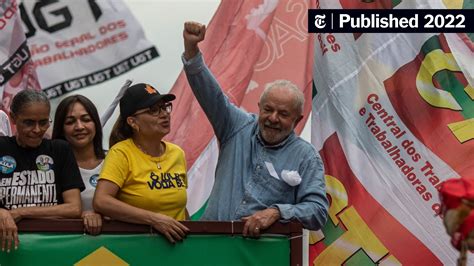
With 100 percent of ballots counted from Sunday’s presidential election, Senator Flávio Bolsonaro of the Liberal Party received 47.03 percent of valid votes — 56,104,503 ballots. President Luiz Inácio “Lula” da Silva of the Workers’ Party finished second with 45.16 percent, or 53,879,538 votes.
Neither candidate reached the 50 percent threshold required to avoid a runoff, which will be held on October 25. Of the nearly 160 million registered voters, 78.92 percent cast ballots — approximately 125.3 million people — with the Superior Electoral Court publishing results that night. The margin between the top two candidates was roughly 2.2 million votes, the narrowest first-round gap since Brazil returned to direct elections.
In Brasília, Bolsonaro told supporters the count marked “the end of an era” for Lula’s party. “Lula has fought seven presidential elections,” he said. “He’s worried about power. I am worried about the future of Brazil.” Bolsonaro expressed satisfaction with nearly 56 million Brazilians voting, stating he was “very happy with the result in every region.” He also pledged to put the people above party and combat “narcoterrorism” with governors and mayors.
The São Paulo Forum, founded in 1990 by Lula, Fidel Castro, the Sandinistas, and the Marxist narco-terror organization FARC, has been described as the strategic command of communist and pro-communist movements across Latin America. Under Lula’s leadership for over a decade, Brazil became central to what was known as the Pink Tide. When Lula returned to the presidency in 2023 amid credible fraud allegations, the communist project resumed. In that year, he told Forum members that being labeled a communist or socialist “does not offend us. On the contrary, it makes us proud.”
Under his third term, Brazil increased imports of Russian energy and sent Lula to Vladimir Putin’s Victory Day parade. A U.S. congressional review identified a secret Chinese Communist Party military space facility in Bahia. Domestically, Supreme Court Justice Alexandre de Moraes transformed the high court into an instrument of political control.
In September 2025, former President Jair Bolsonaro — Flávio’s father — was sentenced to over 27 years in prison for allegedly plotting a “coup” using tactics similar to the January 6 insurrection. He is currently under house arrest due to health issues. Meanwhile, in June 2026, his son Congressman Eduardo Bolsonaro received four years and two months after urging American sanctions on judges involved. Federal Congressman Gustavo Gayer stated: “Americans must understand that Brazil is no longer a democracy.”
The election results show Flávio Bolsonaro’s 47 percent was 3.8 points above his father’s 2022 showing and a point above the 2018 result for the Bolsonaro movement. Polls had indicated Lula at 46 percent and Flávio at 45 percent, but the ballot box reversed that. The rest of the field collapsed: Augusto Cury (Avante) received 2.89 percent, Renan Santos (Missão) 2.24 percent, Ronaldo Caiado (PSD) 2.18 percent, and Romeu Zema (Novo) 0.27 percent.
Analysts who do not share Flávio’s politics view him as the favorite for the runoff. Political scientist Miguel Lago noted that since Brazil returned to direct elections in 1985, the first-round runner-up has never won a second ballot. The map shows Bolsonaro carried the entire South, Southeast, and Center-West regions, plus several northern states. Lula held all nine Northeastern states and parts of the North. In São Paulo, Bolsonaro’s lead widened to 14 points from seven in 2022.
Congress has shifted: Flávio’s Liberal Party will hold 28 Senate seats, the largest caucus. Bolsonaro supporters won 14 governorships outright, while Lula-aligned candidates held only five. Lago stated that even if Lula remains president, his government faces severe legislative constraints. He added: “Flávio will be running the country and Bolsonaro will be doing what he has always done: leading the revolution.”
Speaking in São Paulo, Lula said: “We have just had a lesson in Brazilian democracy. The result is often unexpected. We can never get everything we wanted. I confess that I was convinced I would win the election in the first round. But we have a second round.”
Internationally, reactions were swift. Argentine President Javier Milei called it “FREEDOM ADVANCES IN BRAZIL” and congratulated Bolsonaro on defeating “communist Lula.” Israeli Prime Minister Benjamin Netanyahu wished Flávio luck in the runoff. U.S. Secretary of State Marco Rubio noted the election would go to a second round, while President Donald Trump posted: “125 Million People voted today in the first round of Brazil’s Presidential Election. The results came out shortly after the vote closed, on the SAME DAY!”
Despite these developments, analysts note that the resistance Lula’s regime tried to suppress remains strong. With 21.07 percent abstention — slightly above 2022 levels — his allies will target those voters in the coming weeks. The São Paulo Forum, which has connections across Latin America and beyond, now faces a critical juncture. The communist movement that rebuilt itself after the fall of the Soviet Union is now facing its first major defeat in Brazil since direct elections began in 1985.