
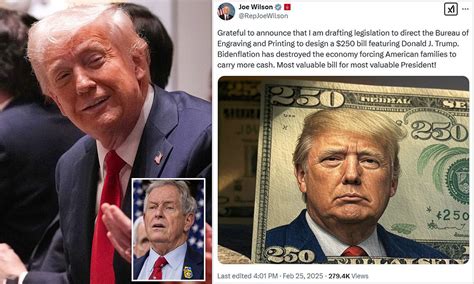
Treasury Secretary Scott Bessent confirmed last Thursday the proposal for a $250 bill featuring President Donald Trump’s portrait, which he described as a potential tribute to America’s semiquincentennial.
The law currently prohibits living individuals from appearing on U.S. currency. Additionally, no $250 Federal Reserve note is authorized under existing legislation. However, proposed congressional legislation has already been introduced to address both issues.
Bessent stated at the White House that his mandate requires U.S. currency to neither include living people nor omit “In God We Trust.” He explained that pending legislation would allow a living person—Donald Trump—to appear on the $250 bill. The Treasury, he said, has prepared in advance for potential legislative changes but will adhere to current law.
Reports indicate Treasury officials have worked with the Bureau of Engraving and Printing to develop designs for the note. Senior Treasury official Brandon Beach and advisor Mike Brown were reportedly involved in efforts starting last year. The bureau’s then-director, Patricia Solimene, raised legal objections before being reassigned.
Bessent clarified that the Treasury has not instructed printing prior to congressional action: “The department said the bureau was conducting ‘appropriate planning and due diligence’ in response to pending legislation.”
An artist who designed a mock-up of the bill confirmed Trump approved changes to the design, including adding colors from the American flag and a logo for the 250th anniversary.
On February 27, Representative Joe Wilson (R-South Carolina) introduced the Donald J. Trump $250 Bill Act (H.R.1761), which would require the Treasury to print $250 bills featuring Trump’s portrait. The bill has attracted 15 Republican co-sponsors.
The rule against living individuals on currency dates back to 1866, after a five-cent note featured Spencer M. Clark. Congress subsequently banned portraits of living people on currency notes.
Historically, presidents have not appeared on circulating currency. Commemorative coins—such as the 1926 half-dollar featuring Calvin Coolidge and the 1995 silver dollar honoring Eunice Kennedy Shriver—are exceptions but do not apply to everyday paper money.
The Treasury’s actions follow a broader pattern of incorporating Trump’s image across U.S. government projects. The administration has already announced that Trump’s signature will appear on new bills—the first time a sitting president’s signature appears on circulating notes. The U.S. Mint released designs for a 2026 semiquincentennial $1 coin featuring Trump, and his portrait has appeared on the 2026 “America the Beautiful” National Parks pass.
The State Department also unveiled a limited-edition passport design for the 250th anniversary that includes Trump’s portrait. A Trump-aligned board at the Kennedy Center added his name to the center before a federal judge ruled it required congressional approval, and the name was later removed. The State Department renamed the U.S. Institute of Peace as the Donald J. Trump Institute of Peace.
The administration has also sought to rename airports after Trump, with legislation introduced for Washington Dulles International Airport (IAD) and signed by Florida Governor Ron DeSantis for Palm Beach International Airport.
This pattern extends to federal initiatives named “TrumpRx.gov,” “Trump Accounts,” and the “Trump Gold Card.”